
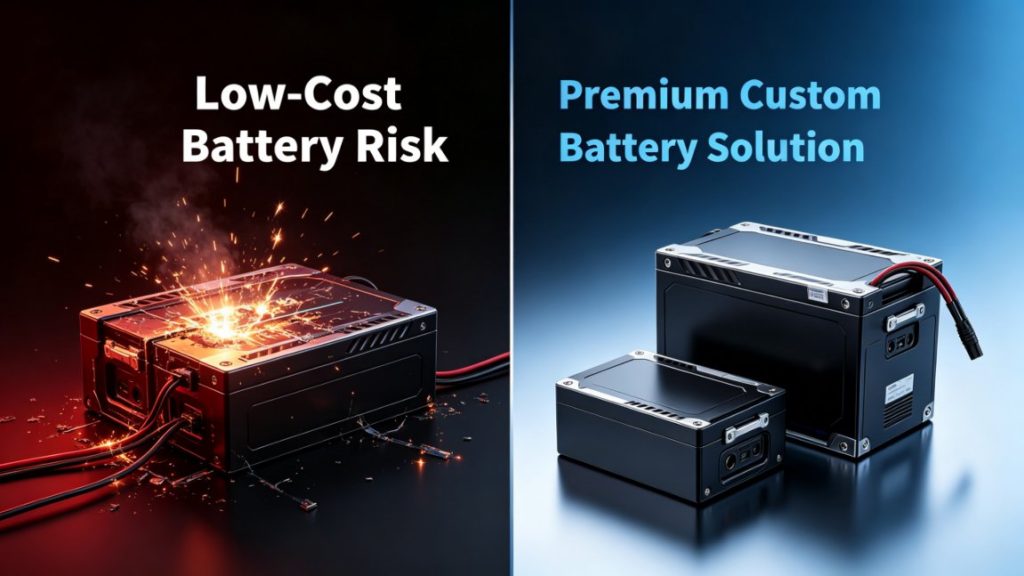
For OEM manufacturers and project developers sourcing lithium battery packs for drones, robots, energy storage systems and electric two/three-wheelers, low pricing is always tempting. Many buyers prioritize upfront cost and choose budget solutions to cut short-term expenses. However, cheap lithium battery packs hide numerous compromised designs and hidden flaws. They often lead to sudden equipment failure, safety accidents, frequent after-sales problems and heavy economic losses in the long run. In battery system procurement, the lowest price always equals the highest hidden cost.
Where Cheap Battery Packs Cut Corners
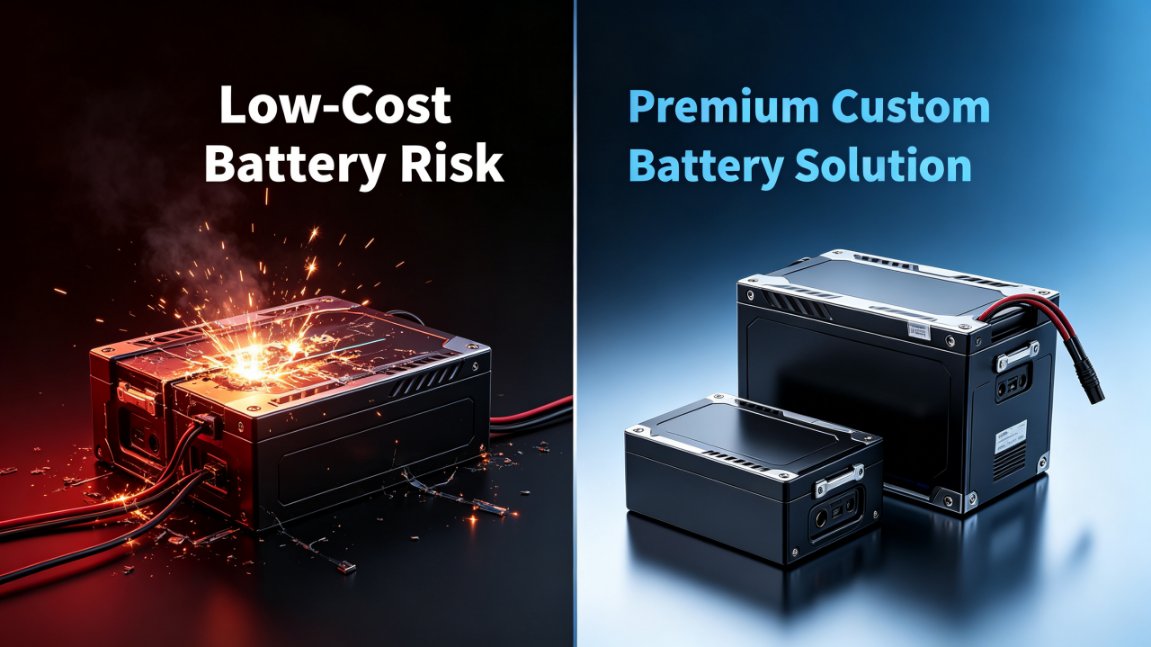
Most low-cost suppliers reduce production cost by sacrificing core quality and safety standards. These covert compromises cannot be identified through simple appearance inspection, but they gradually trigger failures during long-term operation.
1. Generic Outsourced BMS Instead of Custom Firmware
The BMS (Battery Management System) is the intelligent core and safety guard of a lithium battery pack. Low-cost products universally adopt off-the-shelf generic BMS boards with fixed, universal firmware. These standard boards lack targeted algorithm optimization for specific applications. They cannot match the working characteristics of drones, AGV robots, energy storage devices or electric vehicles. Generic BMS suffers from inaccurate SOC/SOH estimation, insensitive fault response, missing professional communication protocols and no OTA upgrade support — laying hidden dangers for stable operation.
2. Grade B / Recycled Cells and Unmatched Cell Combination
High-quality packs require strict screening and precise matching of Grade A cells. To reduce cost, cheap packs often use Grade B cells, recycled cells, or mixed cells with inconsistent internal resistance, capacity and voltage. Mismatched cell combinations cause severe imbalance during charging and discharging. The weakest cell becomes the bottleneck of the entire pack, resulting in rapid capacity attenuation and shortened service life.
3. Insufficient Redundant Safety Protection
Professional industrial-grade packs are equipped with multi-level redundant protection for overcharge, over-discharge, overcurrent, short circuit, over-temperature and insulation faults. Cheap packs simplify protection circuits and remove redundant safety designs, retaining only basic cut-off functions. When abnormal conditions occur, the battery cannot trigger effective protection, easily causing equipment damage and safety accidents.
4. No Vibration and Wide-Temperature Reliability Testing
Drones, mobile robots and two/three-wheel electric vehicles operate in complex environments with frequent vibration, high and low temperature, and high load. Formal manufacturers conduct strict vibration tests, wide-temperature cycle tests and aging tests. Cheap packs skip these key reliability tests, so environmental adaptability is poor and they fail early in harsh scenarios.
Real-World Pain Points Caused by Low-Cost Packs
- Drone / UAV sudden power loss: generic BMS cannot monitor temperature and current stably during high-rate discharge. Mismatched cells cause voltage sag, leading to power cuts in flight, crash accidents and equipment loss.
- AGV and service robot intermittent downtime: inaccurate cell balancing and unstable output cause robots to shut down mid-operation, hurting productivity and raising debugging costs.
- Rapid capacity decay in energy storage: unscreened cells attenuate quickly, drastically reducing backup runtime — far below the rated lifespan.
- Fire risk on 2/3-wheel EVs: simplified BMS protection and untested PACK structures cannot resist long-term vibration and temperature change, making thermal runaway far more likely.
Long-Term Economic Losses
The seemingly low purchase price brings multiplied hidden costs later: frequent downtime disrupts production and delivery; repeated failures surge after-sales maintenance spend; safety accidents trigger compensation claims; and untested products fail international certification, blocking market access and invalidating project investment. For long-term OEM and batch project cooperation, cheap batteries are the most uneconomical choice.
How VastSea Eliminates These Hidden Risks
As a professional custom lithium battery pack and BMS manufacturer, VastSea abandons low-cost corner-cutting designs and relies on in-house R&D and standardized manufacturing:
- Independent BMS hardware and firmware R&D — precise SOC/SOH calculation, active and passive balancing, DroneCAN/CAN/RS485/Bluetooth multi-protocol communication and OTA remote upgrade, with more sensitive multi-level protection.
- 100% Grade A cells and strict cell matching — we reject recycled and Grade B cells. Every cell is screened and grouped for consistent internal resistance, voltage and capacity, fundamentally solving imbalance.
- Full redundant safety protection design — overcharge, over-discharge, overcurrent, short circuit, over-temperature and insulation monitoring, with dual protection to isolate risk in extreme conditions.
- Complete reliability test system — vibration, high/low-temperature cycling, load aging and safety performance testing before every delivery.
- Global compliance and stable after-sales support — complete certification documentation for EU, North American and global markets, plus one-stop OEM/ODM service from sample to mass production.
Conclusion
In the lithium battery industry, you always get what you pay for. Low-cost packs cut price by sacrificing safety, stability and service life. Choosing VastSea’s high-quality custom packs and self-developed BMS means stable performance, long service life and no hidden safety hazards — the most cost-effective long-term choice for drone, robot, energy storage and electric vehicle projects. Visit vspow.com to spec your solution.